"Mac vs PC People: Personality Traits & Aesthetic/Media Choices"
http://blog.hunch.com/?p=10124 -- includes links to full report, which drew on aggregated data from 76,000 PC and Mac users that asked about aesthetic preferences, media choices, and personality traits
Their executive summary:
* Mac People are more likely to see the existing world in a light of “sameness” and thus express a need to be perceived as different and unique. PC People are more likely to see the world as “different enough already” and appreciate “being in tune with those around them.”
* Media choices and preferences vary greatly between the two groups, with Mac People trending toward more independent films, specialized comedians and design-centric magazines, and PC People trending toward more mainstream alternatives as well as sports.
* From a personality perspective, Mac People are more likely to describe themselves as “verbal”, “conceptual”, and “risk takers”, with PC People countering that they are “numbers oriented”, “factual” and “steady, hard workers”.
Fast Company points out that most of these differences can be attributed to the different computer manufacturers' marketing strategies.
And of course the whole report should be taken with a grain of salt.
Tuesday, November 24, 2009


Saturday, August 29, 2009
Saturday, July 25, 2009
Ed Chi's CHI2009 Conference Trip Report
Check out this SlideShare Presentation:
Ed Chi's CHI2009 Conference Trip Report
View more presentations from Ed Chi.
'Living Lab' for HCI - presentation made at HCI International 2009
Check out this SlideShare Presentation:
Wednesday, June 24, 2009
newspapers (Tehrān)
I'm trying to really understand censorship if what this comment on this picture is saying is really true.
"Our Iranian-American guide told us that even though each newspaper is essentially the mouthpiece of a political party, and despite some government censorship, there is still a far broader range of opinions to be found in Iranian newspapers than there is in the mainstream newspapers in the US (because there are far more viable parties than in our two-party system).
Interesting, n'est-ce pas? "
Thursday, June 18, 2009
iPhone in Japan
In May, I was just in Fukuoka Japan and was paying attention to what was going on in the mobile phone area in the last year or so since I last visited. What was interesting to me was that many Japanese mobile users that were using iPhones seems to have two phones. It then dawn on me that iPhone does have a chance in Japan, even if it doesn't support two-handed input. The reason is that people often own two phones in Asia. One is personal, and the other is given by the company.
For many people, the company phone is mostly just a digital leash. The other phone that they buy for themselves, not only represent their taste, it is also an entertainment device for all of the off-clock activities, as well as a fashion device. Turns out that iPhone actually fits this description well. I saw a decent amount of people using iphones to listen to music, play games.
The users on the trains that I saw still could not operate the iphone with one hand, but when they do get a chance to set down, they seem to really enjoy their iphone experience.
Maybe I was wrong after all...
Moreover, maybe Apple will make the enterprise use as smooth as possible.
Wednesday, April 29, 2009
My Review of Salomon Dialogue Snowboard Boots
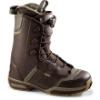
Salomon Dialogue snowboard boots speak to your feet, providing an excellent balance of comfort and support for freestyle-oriented riders.
nice comfortable and solid boot
Ed Chi palo alto, ca 4/29/2009
Gift: No
Sizing: Feels true to size
Width: Feels true to width
Pros: Good Traction, Quality Construction, Warm, Comfortable, Easy Lacing System
Best Uses: All Mountain
Describe Yourself: Advanced
I board about 10-15 days a year, and have finally wore out my Salomon Malamute (4 years old). Had another brand before the Salomon, and didn't like it, so stuck with Salomon this time. This boot compares very favorably to the Malamute, which was an amazing boot. Both boots are very comfortable, and have a great lacing system.
On sizing: The Malamute feels like it's sized a bit bigger (I think I have the 27, which is sized 9 US), while the F24 I also own is smaller (27, sized 9, but feels like 8.5). So this time, I bought a 9.5 US sized, and it fits almost perfectly. A bit thicker in the lining, and took one day on it so far, and the sizing have already improved.
Overall, this is a good boot, and I see they have improved the inner lace, which now have plastic hooks instead of the nylon loops that eventually wore out in my Malamute. The cable stays are also a welcome addition, keeping the boot lacing system more stable (this was also available on the F24 I own).
Thursday, April 16, 2009
Tuesday, April 14, 2009
smiles in yearbooks predict marriage success later?
This is an interesting story, even though we don't know whether correlation here means causation:
"If you want to know whether your marriage will survive, look at your spouse's yearbook photos.
Psychologists have found that how much people smile in old photographs can predict their later success in marriage."
http://news.yahoo.com/s/livescience/20090414/sc_livescience/smilespredictmarriagesuccess
Just got back from Boston....
I hadn't spend some long-periods of time in Boston for a long time. While I went to MIT to give a talk in Janurary, it was snowing and beautiful, this time the weather was somewhat classic New England, some beautiful days that turned into rain and wind in short amounts of time.
I enjoyed some time walking around Boston Commons, Freedom Trail, and some time in Beacon Hill, Newberry St, and North End. Absolutely beautiful neighborhoods, and I could see how people would come to love living in Boston. Some places feel quite like visiting a European city, and other places are distinctly American. The food was good, and I think several Lobsters died because of my greed to incorporate them onto my plate.
My group, Augmented Social Cognition, ended up presenting 8 papers at CHI2009, the conference that brought me to Boston. The group ended up celebrating our accomplishments by some beers near the convention center. It's such a pleasure to work with a dedicated group of folks, though I'm consistently thinking about ways we can improve our research. For now, however, I feel like I need some breaks and vacation before I burn out.
Tuesday, March 24, 2009
Saturday, January 17, 2009
My Review of Yakima Big Powderhound Ski Mount - 6 pair

Carry up to six pairs of skis or four snowboards on your Yakima® roof rack with this nicely designed, easy-to-use Big Powderhound mount.
Whistles at the top of my Xterra
By Ed Chi from Palo Alto, CA on 1/17/2009
Gift: No
Pros: Stable
Cons: Whistles, Hard to Install or Use
So we've had this rack for a few months, including a ride for about 9 hours. It, unfortunately, whistles at the top of our Xterra at highway speeds.
Our Thule, which was on top of our Honda CRV, didn't whistle at all, but unfortunately can't be mounted on top of the Xterra. We're thinking about giving the FatCat 6 a try, but it's quite a bit more expensive.
It's not bad if you don't mind the noise at high speeds.
(legalese)
Tuesday, January 6, 2009
Technology in Sports
I was recently asked by a reporter from the Discovery Channel about technology in sports. Specifically, she wanted to know the top ten ways in which computer technology is changing sports. Here was my response:
Generally speaking, technology in sports can be divided into three
subareas. One is in entertainment or more audience based
augmentations. One other is for refereeing. The final one is for the
athletes.
For entertainment, most of the technology has to do with analytics
augmented sport broadcasting. Additional analysis of the the play
action in real time by analysts using technology has now become a lot
more common place. Line calling in Tennis, freeze frame analyses in
Football. The tricky part of this is that the technology isn't always
well-accepted. The most common example of this is the augmented
hockey puck that was rejected by audiences. The style of presentation
of the trails was quite universally hated.
For refereeing, much of the analytics that are being applied for
audiences are also being used. This is by far the most controversial,
because the traditional sense of "during course of play", the
immediacy of judgments of the referee during the action are essential
parts of many sports games. The augmentation of call reviews in football
took many years to settle down. In soccer, one company in Europe is
augmenting the ball and players to have better triangulation of the
position of each object during play (for better line calls, scoring of
points, etc.)
For athletes, it's probably the most interesting. Much of the
development here has been around body sensors. One interesting idea
(done by both Philips as well as others now) is the use of heart rate
monitors for runners. By monitoring the beat, the music player can
change the music speed to match the desired stride. This was detailed
in a special issue I edited in IEEE Pervasive Computing.
Other interesting sensor work that I've heard recently include:
(1) sensors for helmets (PARC is involved in impact sensors for
soldiers, but it should have sport applications too). My own work on
using impact sensors for judging in Taekwondo is an example of this
kind of technology applied.
(2) sensors for pressure in ski boots. The idea is to be able to
detect weight distribution on the ski boot to see if the techniques
are correct.
(3) sensors that help feedback into the equipment for better
performance. There were some skis and snowboards with active
vibration reduction.
(4) sensors for fatigue (in deciding when to 'sub' someone in soccer).
Tuesday, December 9, 2008
sync my Google Calendar with iCal
I have been looking for a free solution to sync my Google Calendar
with iCal for a while, and I finally found it. A tool is now
available from Google:
"Is having calendar information online, on the desktop, and on a
mobile phone too much to ask? Google apparently doesn't think so
anymore, as the company has quietly enabled sync for Google Calendar,
complete with instructions on how to plug into Apple's iCal.
Thanks to the flexible wonders of WebDAV, or more specifically,
CalDAV, Leopard users can now plug their Google Calendar account
(including those run on Google Apps) into iCal via this simple set of
instructions straight from the Big G's Help Center. Setup involves
plugging a few settings into iCal's Accounts preference pane, after
which the initial sync should happen in a matter of minutes. After
that, any changes made on either end should sync almost instantly.... "
Friday, October 31, 2008
From Cool Science Dept: Mimicking Gecko Feet
From AAAS Science Roundup:
"The ability of gecko lizards to scurry up walls and cling to ceilings by their toes has fascinated scientists for decades. The creatures owe this remarkable ability to microscopic branched elastic hairs on their feet that are able to induce atomic-scale attractive forces to strongly grip surfaces. In a Report in the 10 Oct 2008 Science, Qu et al. reported on the latest attempt to mimic this impressive adhesive effect. The team showed that a disordered array of vertically aligned carbon nanotubes -- consisting of a straight body segment with curly entangled tops -- can achieve macroscopic adhesive forces almost 10 times that of a gecko foot. A strong shear adhesive force, forged when the tangled portions of the nanotubes become aligned when pressed onto a surface, allows for a strong grip of vertical surfaces without slipping, while a much lower normal adhesive force enable easy removal and reattachment. In addition to the ability to stick objects to walls, the material could have many technological applications, including connecting electronic devices and substituting for conventional adhesives in the dry vacuum of space."
"The ability of gecko lizards to scurry up walls and cling to ceilings by their toes has fascinated scientists for decades. The creatures owe this remarkable ability to microscopic branched elastic hairs on their feet that are able to induce atomic-scale attractive forces to strongly grip surfaces. In a Report in the 10 Oct 2008 Science, Qu et al. reported on the latest attempt to mimic this impressive adhesive effect. The team showed that a disordered array of vertically aligned carbon nanotubes -- consisting of a straight body segment with curly entangled tops -- can achieve macroscopic adhesive forces almost 10 times that of a gecko foot. A strong shear adhesive force, forged when the tangled portions of the nanotubes become aligned when pressed onto a surface, allows for a strong grip of vertical surfaces without slipping, while a much lower normal adhesive force enable easy removal and reattachment. In addition to the ability to stick objects to walls, the material could have many technological applications, including connecting electronic devices and substituting for conventional adhesives in the dry vacuum of space."
Wednesday, October 22, 2008
Is it really a myth in "the myth of the paperless office"?

Turns out that the myth might not have been a myth after all! Since 2001, American office workers have been reducing their paper usage. The Economist has a great article on this.
Wednesday, October 15, 2008


Tuesday, October 14, 2008
brain gets smaller when you add alcohol?
Very interesting. So to summarize past research, some moderate drinking
of red wine causes a smaller brain and live longer. (and maybe happier?)
"People who drink alcohol -- even the moderate amounts that help prevent heart disease -- have a smaller brain volume than those who do not, according to a study in the Archives of Neurology."
of red wine causes a smaller brain and live longer. (and maybe happier?)
"People who drink alcohol -- even the moderate amounts that help prevent heart disease -- have a smaller brain volume than those who do not, according to a study in the Archives of Neurology."

Monday, October 13, 2008
Sake as food
From the TrueSake newsletter, comes this interesting bit:
"the genesis of sake (nihonshu or wine of Japan) was not a crystal clear liquid that is best served chilled in fancy bar glasses. ... Like most all things sake can be traced back to ancient China, as this is where rice has its "ground zero."
Farming was a communal occupation, and rice was the most communal of bonds. It was a food source - so valued that at one time it was even traded as a currency. But more importantly rice brought people together. It brought folks together to chew and spit! Yes, the earliest recorded history of sake spoke about a form of brew that was created by chewing rice and spitting the gob into a wooden bucket - "kuchikami no sake" or "chewed in the mouth sake."
Those glorious farmers somehow realized that if they chewed the rice and spat it out into wooden tubs or buckets that the enzymes in their mouths would break the long-chain starch molecules into a glucose, and then this glucose would sit in the bucket for about a week and allow airborne yeasts to propagate and ferment the glucose into wonderful alcohol.
Bingo! A meal and a party in one! And that is indeed what happened. Villages used religious occasions to get groups together to chew and spit en mass to create a large batch of saliva sake - my words not theirs. ...
Then and thankfully some smart and perhaps germaphobic farmer said "I am sick of drinking Yoshi's spit," and suggested that he would prefer the ricey spit of a virgin. And so began the next phase of sake in its oldest form - Bijinshu or "beautiful girl sake" that basically was a virginal masterpiece.
Yes, the village virgins would all gather and chew rice as a team descended from the gods.
Subscribe to:
Posts (Atom)